



Latin America has quietly become one of the biggest stablecoin markets on earth. Inflation, weak currencies and expensive remittances have pushed millions of people toward dollar pegged tokens like USDT and USDC simply to protect their savings.
What started as a survival tool in countries like Argentina has grown into a full investing option, with local exchanges, neobanks and even banks now offering yield on stablecoin holdings.

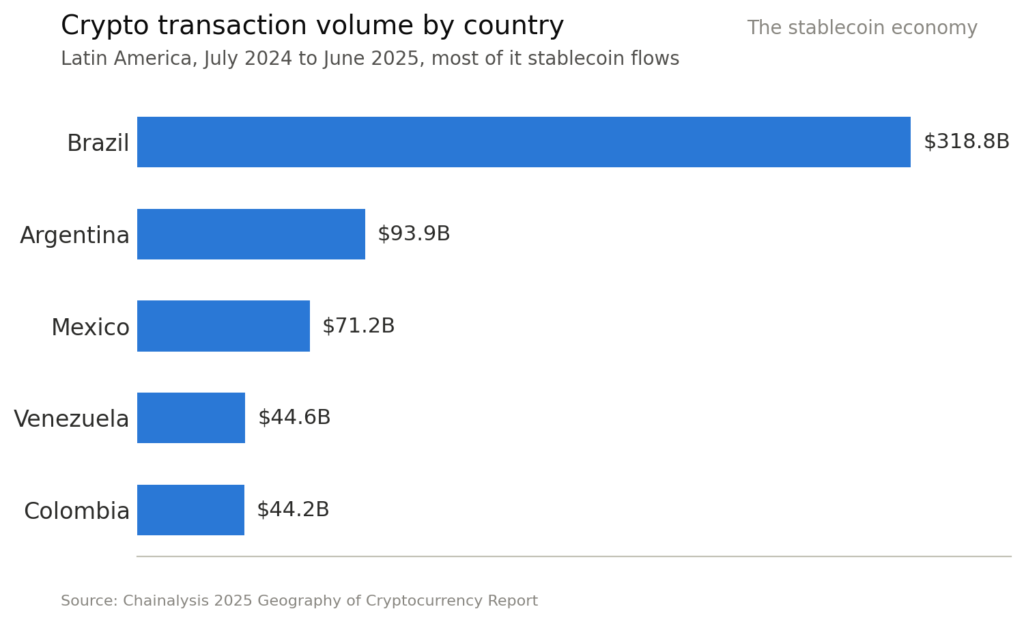
If you are new to this world, here is a simple breakdown of how the industry looks in four of the region’s biggest markets, followed by the steps you actually need to get started.
Four countries leading the stablecoin Boom
1. Argentina: the inflation hedge capital
Argentina has the highest per capita stablecoin adoption in the world. With inflation running well above 100 percent for years, many Argentines convert their peso salaries into USDT almost immediately to preserve value.
Local apps like Lemon and Belo make this simple, letting users hold, spend and even earn yield on stablecoins through a regular mobile app rather than a traditional bank.
Since 2025, exchanges operating in the country need to register as virtual asset service providers, which has added a layer of legitimacy to the market. For a beginner, Argentina is proof that stablecoins are not just a trading asset but a daily financial tool.
2. Brazil: the region’s biggest and most regulated market
In addition, Brazil now moves more stablecoin volume than any other country in Latin America, with the vast majority of all crypto flows tied to dollar pegged tokens.
The Central Bank has classified stablecoin transactions as foreign exchange operations, and exchanges need proper authorization with meaningful capital requirements. This has attracted serious institutional players like Nubank, Mercado Pago and even Itaú, Brazil’s largest bank.


Local projects such as BRL1 and BBRL are also building real backed stablecoins pegged to the Brazilian real.
Brazil is a good entry point for anyone who wants regulatory clarity alongside strong liquidity.
3. Mexico: remittances meet stablecoins
Mexico receives one of the largest remittance flows in the world, most of it from the United States, and stablecoins are increasingly used to move that money faster and cheaper than banks or wire services allow. Platforms like Bitso have built entire businesses around this corridor, combining stablecoin settlement with Mexico’s instant payment system SPEI.
Banks such as BBVA Mexico have reported sharp growth in stablecoin transaction volume, and a broader regulatory framework for digital assets continues to develop.
Mexico is a strong option for beginners who care about cross border transfers as much as savings.
4. Colombia: the fast rising newcomer
On its part, Colombia is smaller than the other three markets but is growing quickly as its peso weakens and fiscal pressure builds. Nearly all peso purchases on local exchanges flow straight into stablecoins, showing that most users are there for dollar exposure rather than speculation.
Local platforms like Littio have built products specifically around dollar denominated savings with competitive yield, while Bancolombia’s Wenia platform launched a peso backed stablecoin called COPW.
Colombia is worth watching closely since its adoption curve looks similar to Argentina’s a few years ago.
Step by Step: How to start investing
- Pick a country context that matches your goal. Decide whether you want inflation protection, cheaper remittances or simple dollar savings, since each of the four markets above leans toward a different use case.
- Choose a regulated platform. Look for exchanges or neobanks registered with local authorities, such as Bitso in Mexico, Lemon or Belo in Argentina, or Nubank and Mercado Pago in Brazil. Avoid unregistered platforms even if they promise higher returns.
- Verify your identity. Most platforms require standard know your customer checks including a government ID and proof of address before you can deposit funds.
- Fund your account with local currency. Use bank transfers, PIX in Brazil, SPEI in Mexico or a linked debit card, then convert those funds into a stablecoin such as USDT or USDC.
- Decide between simple holding and yield products. Some platforms let you just hold stablecoins as digital dollars, while others offer savings accounts or DeFi backed yield programs through providers like Aave.
- Diversify across stablecoins and platforms. Do not keep everything in a single token or app, since even well regulated stablecoins can carry risk, as USDC’s brief depeg during the 2023 banking crisis showed.
- Monitor local regulation. Rules are still evolving quickly across the region, so check for updates from your country’s central bank or financial regulator every few months.
Stablecoins have moved from a niche crypto product to core financial infrastructure across Latin America.
Starting small, choosing regulated platforms and understanding your own reason for investing will put you ahead of most beginners entering this space.