



For years the pitch for stablecoins in Africa went something like this: currencies wobble, banks are slow, and a token pegged to the dollar solves both problems at once. It was a good pitch, and millions of Africans acted on it anyway, trading dollar-tokens on peer-to-peer apps that regulators mostly tolerated and rarely understood.
What has been missing is the second half of the story — the moment stablecoins stop being something people do around the banking system and start being something built into it. This week’s investment by Circle Ventures, the venture arm of the American stablecoin issuer, in Flutterwave, Africa’s most valuable fintech, is as clear a signal of that shift as the industry has produced.
The terms were not disclosed, which is standard practice for strategic rounds where the money matters less than the plumbing. What matters here is the plumbing. Flutterwave will now embed Circle’s USDC token directly into its settlement infrastructure, letting merchants accept payment in naira, cedi or shilling while the company settles the transaction in digital dollars behind the scenes. Businesses need not know or care that a stablecoin touched their money at all; they will simply notice that it arrived faster and survived the trip with less shaved off by intermediary banks.
A pattern, not an experiment
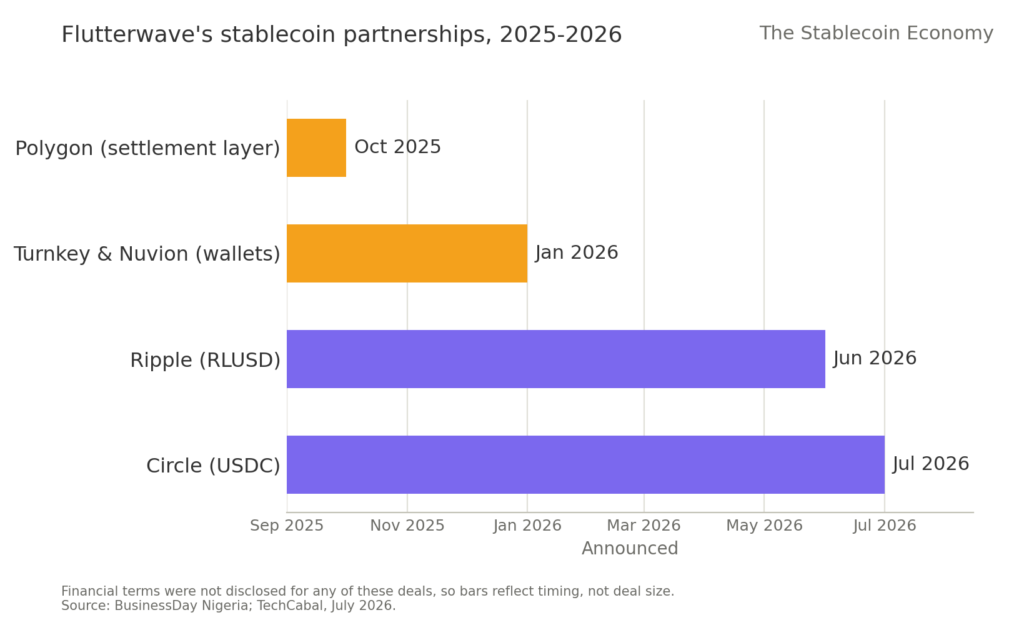
This is not Flutterwave’s first flirtation with the technology, merely its most consequential. Over the past nine months the company has quietly assembled a portfolio of crypto partnerships rather than committing to a single rail:
- October: adopted Polygon as a settlement layer
- January: stood up stablecoin wallets built with Turnkey and Nuvion
- June: struck a deal to weave Ripple’s RLUSD token into its products
- July: took on Circle’s USDC as its fourth major stablecoin partner
Read together, that sequence looks less like experimentation and more like a company deliberately assembling optionality, hedging across blockchains and issuers so it never has to explain to a merchant in Accra why a single rail went down.

Flutterwave’s chief executive, Olugbenga Agboola, put it plainly: “Stablecoins like USDC are no longer an experiment; they are becoming core financial infrastructure,” he told BusinessDay.
Stablecoins now account for more than $300bn in circulation worldwide, and Africa is among the fastest-growing markets for them, driven by currencies that lose value with dispiriting regularity and cross-border payment rails designed for an era when a wire transfer taking three days was considered acceptable.
For Circle, the arrangement buys distribution in a market where USDC trails Tether’s USDT by a wide margin; Flutterwave’s reach across 34 African countries and $50bn in processed transactions is not something Circle could easily replicate alone.
What regulators actually want
Meanwhile, the more interesting audience for this deal, though, may be regulators rather than merchants. The Central Bank of Nigeria has spent the past few years alternating between hostility toward crypto and grudging acknowledgement that its citizens were using it anyway; it has since floated a licensing framework for stablecoin issuers, following similar moves elsewhere on the continent.


A great deal of stablecoin activity in Africa still happens on informal peer-to-peer platforms that regulators can see but not really supervise. If that activity migrates instead to a licensed, compliance-first fintech like Flutterwave, central banks get something they have wanted all along: visibility, without having to ban the thing they cannot fully see.
That, at least, is the argument Flutterwave is making, and it is a more careful one than it might have made three years ago. The company is explicit that it is not promoting cryptocurrency trading, but positioning USDC as a settlement tool operating inside existing financial rules. This is the same rebranding exercise stablecoin firms have performed globally, from Visa’s pilot paying gig workers in USDC to Western Union’s plan to launch its own dollar token: recast a crypto-adjacent product as payments infrastructure, and the regulatory conversation shifts from whether the thing should exist to how it should be licensed.
Not everyone is reassured
On their part however, critics of dollar-backed stablecoins argue that embedding them ever deeper into everyday commerce quietly erodes the monetary sovereignty of the countries whose currencies they are designed to sidestep, a concern that does not disappear simply because the rails are now run by a regulated fintech instead of an anonymous trader on Telegram.
Whether Africa’s central banks end up seeing Flutterwave’s approach as a solution to that problem or merely a more presentable version of it will shape how much further this trend can run. For now, the direction of travel is unmistakable: stablecoins are leaving crypto trading obscurity and moving into infrastructure, one settlement rail at a time.