


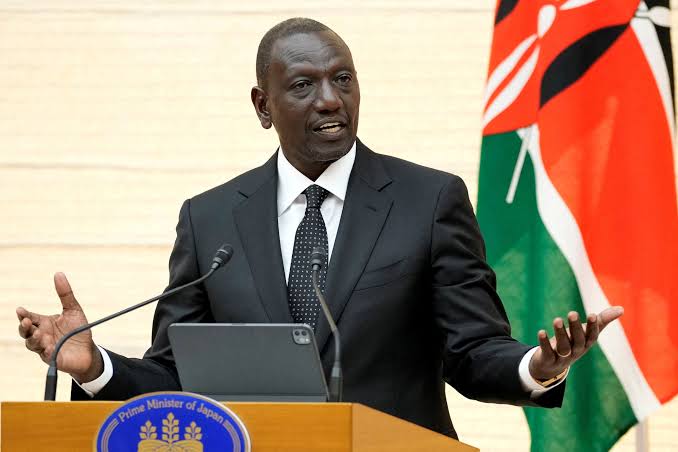
Nairobi has fired the opening shot in what may become Africa’s defining financial policy battle of the decade. With the publication of its Virtual Asset Service Providers (VASP) regulations, Kenya has staked out a clear position: digital dollars will not flow freely through its economy without the central bank’s blessing.
Under the new framework, which completes the implementation of the Virtual Asset Service Providers Act, 2025, the Central Bank of Kenya becomes the gatekeeper of the country’s digital currency economy.
Its powers are sweeping. The regulator can instruct licensed intermediaries to limit access to foreign-issued stablecoins, the USDTs and USDCs that have quietly become the workhorses of African cross-border commerce.

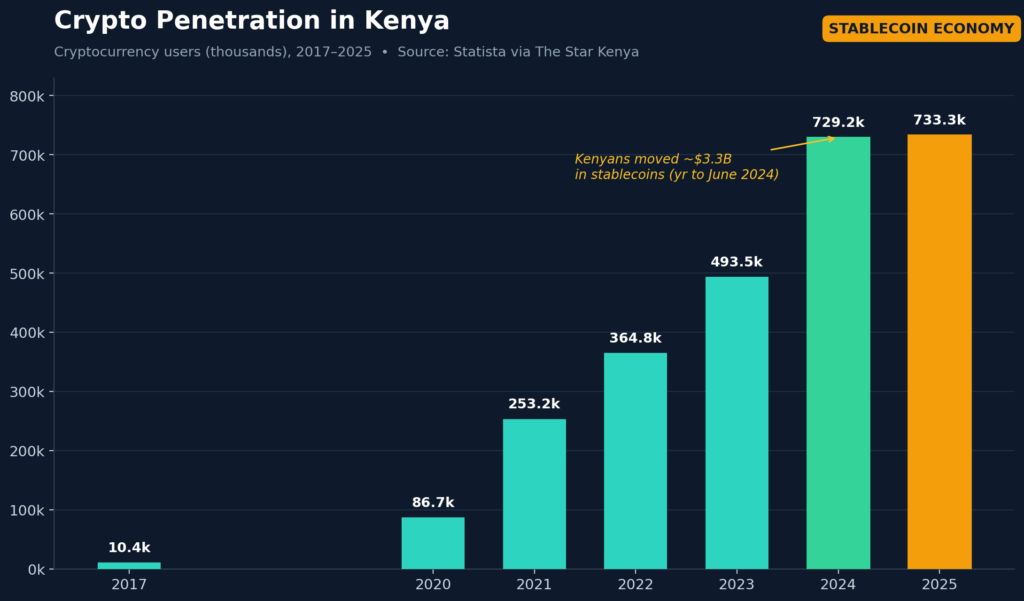
And before any stablecoin appears on a regulated Kenyan exchange, it must first clear two hurdles: approval from the central bank and issuance by a licensed operator.
For a country that has long positioned itself as East Africa’s fintech capital, the birthplace of M-Pesa and a magnet for blockchain startups, the message is unambiguous. Innovation is welcome. Unsupervised capital flight is not.
The dollarization dilemma often overlooked
To understand why Kenyan regulators are moving so assertively, look west to Nigeria. There, the explosive adoption of dollar-pegged stablecoins prompted the International Monetary Fund, in its report Stablecoins in Nigeria, to flag risks around capital flow management and financial stability.
The pattern worries central bankers across the continent: citizens and businesses, seeking refuge from volatile local currencies, increasingly park their money in tokens backed by the US dollar.
Each transaction that migrates to a dollar-denominated stablecoin is, in effect, a small vote of no confidence in the local currency, and a small transfer of financial gravity toward American issuers.
Multiply that by millions of users, and the arithmetic becomes alarming. Businesses gain speed and convenience; the state risks losing the levers of monetary policy.
Kenya’s regulators are betting that a licensed, supervised stablecoin ecosystem can capture the benefits of the technology without surrendering monetary sovereignty in the process.
The continent follows suit, and so does the world
Kenya is not acting in isolation. Just days earlier, on August 3, South Africa published draft guidelines governing cross-border cryptocurrency payments, signaling Pretoria’s own appetite for tighter control. Further afield, the European Union’s Markets in Crypto-Assets (MiCA) regime already requires stablecoin issuers to be authorized, while both the United States and Singapore are hardening their oversight frameworks.
The direction of travel is global: the era of stablecoins operating in a regulatory vacuum is closing fast.
Yet there is a catch, and it is enormous. Stablecoins derive their usefulness not from regulation but from ubiquity. Pankaj Bengani, co-founder of the digital asset network Meld and a former executive at Jack Dorsey’s Block, applauds Kenya for “moving stablecoins into a regulated framework rather than leaving the market in uncertainty.” But he is quick to add a caveat: “the value of stablecoins comes from network effects.”
“As stablecoins become more widely used, policymakers naturally want to preserve monetary sovereignty and ensure local currencies continue to play a central role in the domestic economy,” Bengani tells FORBES AFRICA. “But, at the same time, dollar-denominated stablecoins processed approximately $32 trillion to $32.5 trillion of the ~$33 trillion total, or about 96%-98% of global stablecoin transfer volume in 2025.”


That is the liquidity ocean Kenyan businesses currently swim in. A locally issued, shilling-backed stablecoin may satisfy regulators, but it cannot conjure that depth of liquidity by decree. If access to USDT and its peers is restricted before homegrown alternatives achieve comparable reach, Kenyan firms could find themselves cut off from the cheapest, fastest rails for international payments: paying more, waiting longer, and watching competitors in less restrictive jurisdictions pull ahead.
The irony, as Bengani frames it, is that a policy designed to protect the economy could instead backfire: “the unintended consequence could be a more fragmented market with higher costs for cross-border payments.”
Walking the tightrope of legislations
On its part, the Central Bank of Kenya now faces one of the more delicate assignments in modern financial regulation: building a two-tier system in which local stablecoins can grow and flourish while foreign ones remain accessible enough to keep Kenya plugged into global liquidity.
Sequencing will be everything. Move too slowly on enforcement, and the dollarization drift continues unchecked. Move too fast, and businesses get stranded on an island of well-regulated but shallow liquidity.
Kenya has chosen clarity over chaos, a decision few would fault. Whether that clarity becomes a foundation for growth or a wall against it will depend entirely on how the rules are applied in the months ahead. The rest of the continent, drafting its own frameworks, will be watching closely.