



Brazil has become Latin America’s largest digital asset market, and its exchanges have moved well past simple buy-and-sell trading.
Pix made instant bank transfers a daily habit for most Brazilians, and that same appetite for speed has carried over into crypto. Roughly 90% of all crypto flow in the country now passes through stablecoins, according to Banco Central president Gabriel Galipolo.
A new regulatory framework, Resolutions 519, 520 and 521, is rolling out through 2026 and brings stablecoin operations formally inside Brazil’s foreign exchange rules.
Below are ten platforms built for or heavily used across Brazil, followed by what makes each one distinct.
Ten platforms powering Brazil’s stablecoin economy
10. NovaDAX
NovaDAX lists several hundred digital assets and has built a reputation among Brazilian traders for its breadth of altcoin pairs priced directly in reais. It sits alongside Mercado Bitcoin and Foxbit as one of the three homegrown exchanges most Brazilians open first.
9. Bitso Onchain
Bitso, the Mexican-founded exchange with deep Brazilian operations, rolled out Bitso Onchain in 2025, a decentralized trading layer giving Brazilian users access to more than 17,000 tokens across 14 blockchains without gas fees or seed phrases. It marked the company’s formal entry into DeFi rather than pure custodial exchange services.
8. Cainvest
Cainvest is the liquidity provider behind BRL1, the real-pegged stablecoin issued jointly by Bitso, Mercado Bitcoin and Foxbit. Cainvest supplies the market-making infrastructure that keeps BRL1 trading close to parity with the Brazilian real across the consortium’s exchanges.
7. Foxbit Infra
Foxbit’s institutional arm lets digital banks and fintechs plug stablecoin rails, custody and cross-border settlement into their own apps through a single API, without obtaining their own crypto licence. Its Prime Desk product settles reais-to-dollar corporate transfers using stablecoins behind the scenes, a structure Foxbit has called invisible to the end client.
6. Foxbit
One of Brazil’s oldest exchanges, founded in 2014, Foxbit pairs roughly 100 cryptocurrencies with tight BRL spreads and has increasingly focused on business-facing stablecoin infrastructure alongside its retail trading app.
5. BRL1 consortium
BRL1 itself deserves a place on this list as much as any single company. Backed by Brazilian treasury bonds and issued jointly by Bitso, Mercado Bitcoin, Foxbit and Cainvest, it trades fee-free against the real on every consortium exchange and was designed to cut the friction of moving value between Brazilian platforms.
4. DREX ecosystem participants
DREX, the Central Bank of Brazil’s digital real project, is not a yield farming platform, but the banks and fintechs piloting it are increasingly the same names building stablecoin rails. Its progress shapes how much room private stablecoins like BRL1 will have to operate alongside a state-backed digital currency.
3. Binance Brazil
Binance holds a local broker-dealer licence and offers Brazil’s lowest headline trading fees, often near 0.01%, along with a far larger asset list than domestic competitors. It remains the default choice for Brazilians who prioritise liquidity and altcoin selection over local customer support.
2. Mercado Bitcoin
Latin America’s largest crypto exchange, based in São Paulo, offers more than 450 digital assets including passive income products through staking and crypto-backed lending. It holds Banco Central authorisation as a payment institution and has operated 13 years without a major security incident, a track record it markets heavily to risk-conscious Brazilian savers.

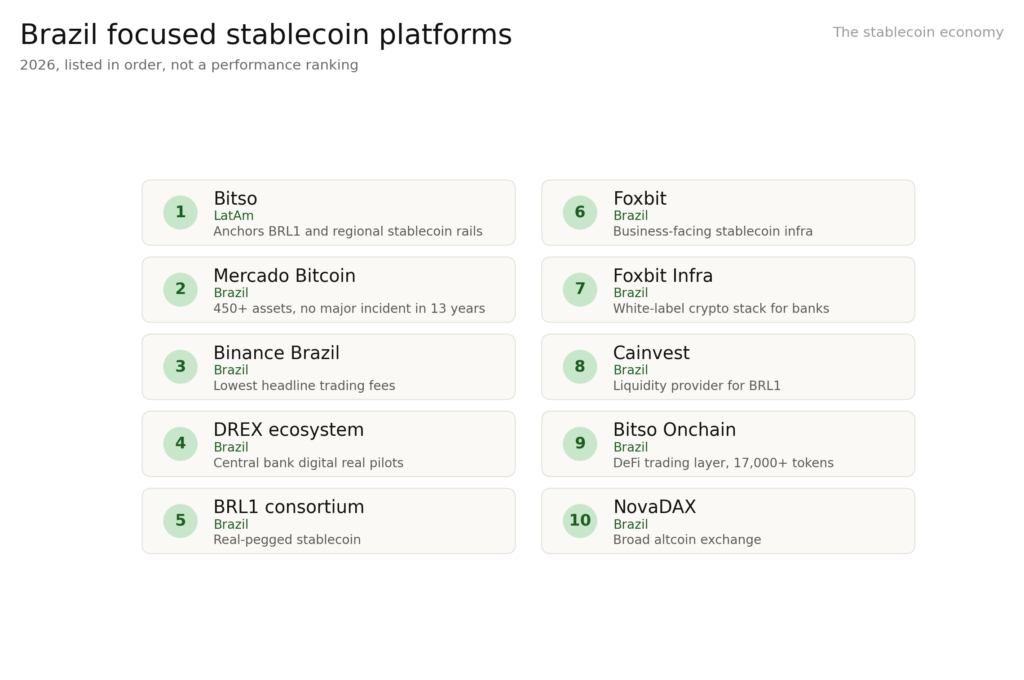
1. Bitso
Bitso anchors the BRL1 consortium and pairs its Brazilian operations with the broadest stablecoin infrastructure business in the region, Bitso Business, which now processes cross-border payment volumes that grew 81% year-on-year in the first half of 2026. Its scale across Mexico, Brazil, Argentina and Colombia gives it the clearest shot at becoming the default settlement layer for Brazilian stablecoin flows.
Bottom line
Brazil’s stablecoin market has moved past speculation into infrastructure that banks, fintechs and regulators are actively building around. With Bacen’s new stablecoin rules phasing in through 2026 and a real-pegged token already live across the country’s biggest exchanges, the direction of travel favours platforms with clean regulatory standing over those chasing the highest advertised yield. Starting with a licensed, well-established exchange, keeping deposits diversified and watching how the Resolution 521 rules bed in will put any new investor in a stronger position.