



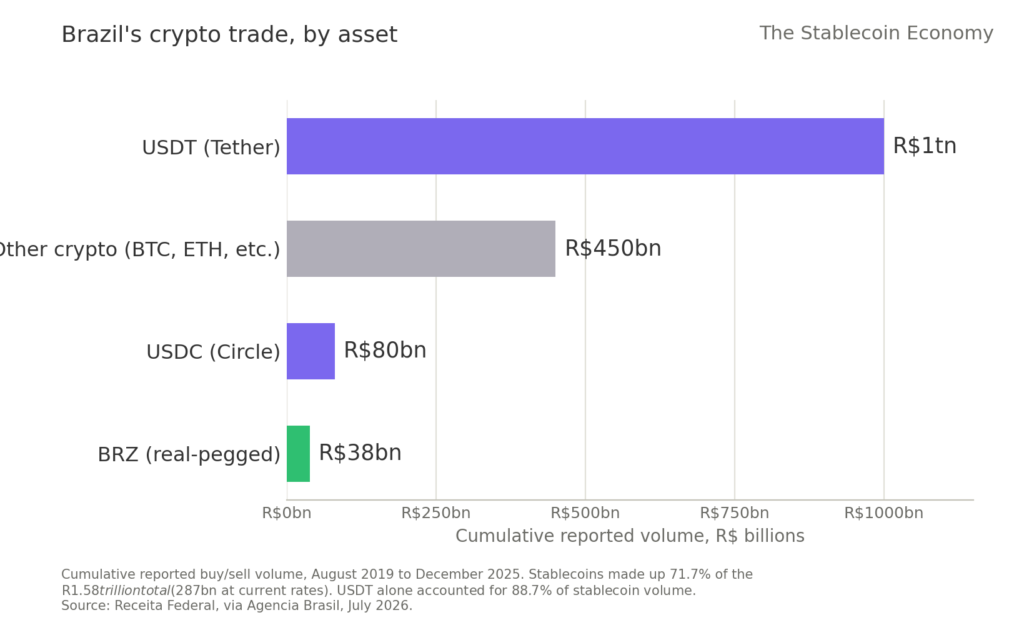
Brazil has become one of the world’s fastest-growing stablecoin markets. Every month, between $6 billion and $8 billion worth of stablecoin transactions flow through the country, with dollar-pegged tokens now accounting for roughly 90% of all crypto activity, according to Brazil’s tax authority, Receita Federal. Around 25 million Brazilians now own or use cryptocurrencies, helping propel the country from tenth to fifth place in global crypto adoption rankings in 2025.
That rapid growth has forced Brazil’s regulators into difficult territory.
Over the past few months, the Central Bank of Brazil (BCB) has taken two significant steps that could reshape how stablecoins operate in the country’s financial system. First, it restricted the use of cryptocurrencies for certain cross-border payment settlements. Second, it opened a debate over whether stablecoins should be regulated as electronic money rather than as conventional crypto assets.
Together, the moves signal a broader shift in Brazil’s approach to crypto regulation. The central bank appears determined to bring stablecoins in the country under a framework that more closely resembles traditional finance. The crypto industry, however, argues that doing so could undermine one of Latin America’s fastest-growing digital asset markets.
Brazil closes one of stablecoins’ biggest payment use cases
The first policy change came on April 30, when the BCB published Resolution 561.
The regulation, which takes effect on October 1 with compliance deadlines extending into 2027, prohibits fintechs and payment providers licensed under Brazil’s electronic foreign exchange (eFX) framework from settling international transactions using stablecoins, bitcoin or any other cryptocurrency. Instead, settlements must pass through traditional foreign exchange transactions or non-resident real-denominated accounts.
The change targets a payment model that had become increasingly common among fintech companies.
Previously, a remittance provider could receive Brazilian reais from a customer, convert the funds into USDT, USDC or bitcoin, transfer the assets across a blockchain network, and convert them back into local currency overseas. The blockchain acted as the settlement layer, allowing firms to move money faster and often more cheaply than conventional banking rails.
Under Resolution 561, that workflow is no longer permitted for eFX-licensed firms.


The companies most affected are those that built cross-border payment infrastructure around blockchain settlement. They include Nomad, which used Ripple’s network to facilitate transfers between Brazil and the United States, and Braza Bank, the issuer of BBRL, a Brazilian real-backed stablecoin.
The restriction is narrower than it first appears.
The regulation does not ban stablecoin trading or prohibit cryptocurrencies from being used in international payments altogether. Licensed Virtual Asset Service Providers (VASPs) can still facilitate cross-border stablecoin transactions under Resolution 521, which came fully into force this year.
That distinction is particularly important for institutions such as Braza Bank. Because it also operates as a licensed VASP, the bank can continue issuing and using BBRL through that regulatory framework rather than the eFX system. Its real-backed stablecoin, with a market capitalization of roughly R$61.6 million ($12.3 million), already circulates across multiple blockchain networks.
In effect, the central bank has drawn a regulatory line. Stablecoins can remain part of Brazil’s financial system, but not as the settlement infrastructure for payment providers operating under the country’s eFX rules.
The bigger battle: Are stablecoins electronic money?
The cross-border restrictions may be significant, but the larger debate concerns how Brazil legally defines stablecoins.
Fábio Araújo, an adviser in the BCB’s Regulation Department, has proposed classifying stablecoins as electronic money rather than treating them as another category of cryptocurrency.
The argument is straightforward.
Bitcoin and ether largely function as investment assets whose prices fluctuate freely. Stablecoins, by contrast, are designed to maintain a fixed value by being backed by fiat currencies or highly liquid financial assets. In practice, they behave less like speculative assets and more like digital payment instruments.
If the proposal is adopted, stablecoin issuers would fall under Brazil’s electronic money regulations. That would likely require them to meet stricter capital requirements, consumer protection obligations, operational standards and anti-money laundering controls similar to those already applied to payment institutions.
For the crypto industry, however, the proposal raises concerns about regulatory overreach.
The Brazilian Crypto Economy Association (Abcripto), whose members include Binance, Coinbase and Tether, has formally opposed the proposal.
The association argues that stablecoins differ fundamentally from traditional electronic money and should be regulated through a dedicated framework instead of being forced into rules designed for payment institutions. According to Abcripto, applying electronic money regulations could increase compliance costs, discourage innovation and slow adoption among both businesses and consumers.
The group also argues that Brazil risks diverging from international regulatory trends. Markets including the European Union and the United Kingdom are developing bespoke stablecoin regimes rather than folding the assets into existing electronic money legislation.
For an industry that increasingly operates across borders, regulatory alignment matters. If Brazil adopts a framework that differs significantly from other major jurisdictions, crypto companies could face higher compliance costs and become less willing to expand operations in the country.
A broader regulatory tightening
The debate extends beyond electronic money classification.
Earlier this year, industry associations representing more than 850 companies opposed proposals to extend Brazil’s IOF financial transaction tax to stablecoin-related activity, arguing that additional taxes could reduce competitiveness and discourage innovation.
Meanwhile, the central bank has introduced stricter oversight for Virtual Asset Service Providers, including stronger capital requirements, enhanced risk management standards and mandatory audits, bringing crypto firms closer to the regulatory standards already applied to traditional financial institutions.
Brazil’s plan more than a redefintion
Taken together, the measures reveal a regulator trying to keep pace with one of the world’s fastest-growing crypto markets.
The Central Bank of Brazil is not attempting to remove stablecoins from the financial system. Instead, it is deciding where they fit within the country’s existing regulatory architecture and how closely they should resemble traditional financial products.

That distinction matters.
With between $6 billion and $8 billion in monthly stablecoin transactions and one of the highest crypto adoption rates in the world, Brazil has become one of the industry’s most important emerging markets. The central bank’s decision on whether stablecoins should be classified as electronic money will influence not only domestic innovation but also how attractive Brazil remains for global crypto companies looking to expand across Latin America.
The BCB is expected to announce its final position later this year. Given Brazil’s growing influence in digital finance, the outcome is likely to shape stablecoin regulation well beyond its borders.