


Latin America moved $730 billion worth of crypto in 2025. Of that, $324 billion, close to half, ran through stablecoins, up 89% from the year before. This is a description of how money actually travels across the region now, from a salary in Buenos Aires to a supplier payment in São Paulo to a remittance crossing from Miami into Bogotá.
The story of that money is not evenly spread.
It concentrates in a handful of countries, each pulled toward stablecoins for a slightly different reason, and together they sketch a map of what dollarization looks like when it happens on a blockchain instead of at a bank.

Brazil is where the volume lives
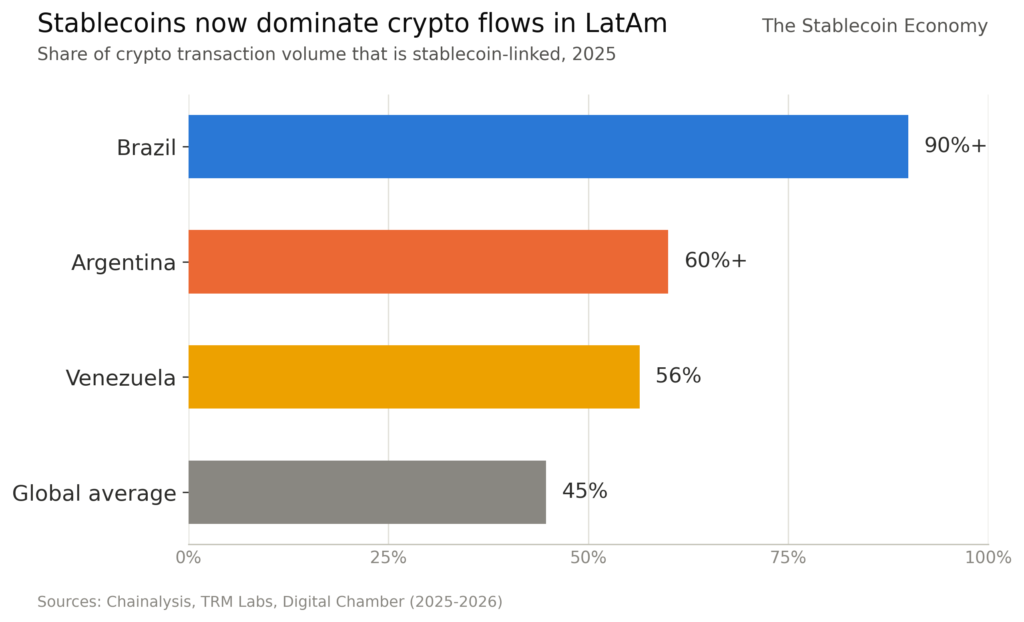
Start with the biggest number on the board. Brazil received $318.8 billion in crypto value in the year tracked by Chainalysis, close to a third of everything that moved through Latin America. More than 90% of that is stablecoin linked.
On local exchanges, stablecoin volume grew more than 200% year over year, comfortably outpacing every other crypto asset in the country.
What is notable about Brazil is who is behind that volume. This isn’t purely a grassroots story of people dodging a broken currency. Brazil passed its Virtual Assets Law early, giving banks and neobanks a clear regulatory lane to build on. Itaú, one of the country’s largest traditional banks, has moved into the space, and neobanks like Nubank and Mercado Pago have followed. Institutional-sized transactions have been climbing steadily since the middle of the last cycle.
Brazil is proving that stablecoins do not need a currency crisis to scale.
A large, tech-comfortable population and a regulator willing to write rules early were enough.
Argentina is swapping pesos for digital dollars
Argentina tells a more familiar story, but the scale of it is still striking.
Stablecoins now account for more than 50%, and by some counts over 60%, of all peso exchange purchases in the country. USDT and USDC together made up 72% of crypto purchases in Argentina in a recent measured year, a level well above the roughly 45% global average.
The mechanism is blunt and easy to trace. Every time the peso drops, stablecoin trading volume spikes within weeks. When the currency lost sharp value around a major political announcement, stablecoin trading value on a leading regional exchange jumped past $10 million almost overnight. Argentines are not buying stablecoins to speculate. They are buying them the way people buy dollars under a mattress, except the mattress is now a wallet app, and it settles instantly.
Colombia and Mexico are building the payment rails
If Brazil is about scale and Argentina is about currency flight, Colombia and Mexico are where stablecoins are quietly becoming payment infrastructure rather than a store of value.
Colombia is layering stablecoins onto its existing local payment rails for cross-border transfers, rather than replacing them outright. Mexico, meanwhile, sits inside the single largest remittance corridor in the world, and stablecoins are cutting the cost of moving money along it dramatically.
Fees on the US-Mexico corridor have fallen to under 1% through stablecoin rails, compared with the 5% to 7% typically charged through traditional remittance channels.
That gap, multiplied across a corridor worth tens of billions of dollars a year, is why banks and fintechs on both sides of the border are racing to build stablecoin-native rails rather than defend the old ones.
The remittance map is shifting in other ways too. Mexico’s share of regional remittances actually fell in 2025 even as total flows into Latin America held around $174 billion, while transfers into Central America rose sharply.
Lower-profile corridors, like Venezuela to Colombia and Argentina to Bolivia, are becoming more active, and stablecoins are increasingly the rail underneath them.
Venezuela is the extreme case that shows where this goes
No country in the region makes the case for stablecoins more starkly than Venezuela. Annual inflation there reached the hundreds of percent in recent years, and the bolívar lost a large share of its value in a single year.
In response, USDT has become something close to an informal second currency. Corner shops price goods in it. Freelancers invoice in it. Payroll at small and mid-sized businesses in cities like Caracas and Valencia increasingly runs through it.
The numbers back up the anecdotes. On Binance’s peer-to-peer marketplace, the most popular exchange venue in the country, over 90% of listings now involve USDT, compared with under 2% for bitcoin paired against the bolívar.
Roughly 9% of Venezuela’s remittances, out of a market worth more than $5 billion a year, now arrive as crypto rather than through a bank. Venezuela ranks 18th globally for crypto adoption by raw volume, but ninth when adjusted for population size, which is the more honest number.
This is not a wealthy elite dabbling in digital assets. It is a country running large parts of its retail economy on a token pegged to a currency it does not issue.
What the region has in common
Pull back from any single country and a few patterns hold across all of them.
- Cross-border payments are the anchor use case. 71% of Latin American institutions already use stablecoins for cross-border payments, the highest adoption rate of any region in the world, well above the roughly 49% global average.
- The infrastructure is already mostly built. 86% of firms in the region report stablecoin integration partnerships already in place, and 71% say their infrastructure is ready to scale further.
- Demand is still climbing, not plateauing. 75% of firms report growing customer interest, which suggests the current volume is closer to the early stage of a curve than the top of one.
- B2B is catching up to remittances. Business-to-business stablecoin payment volume grew more than 700% year over year in 2025, and now makes up roughly 60% of all stablecoin payment volume in the region, as contractor payroll and corporate treasury transfers move onto the same rails that once carried mostly personal remittances.
Final thought
What ties Brazil’s institutional build-out to Venezuela’s street-level dollarization is the same underlying fact. In a region where currencies are unreliable, banking access is uneven, and cross-border fees have historically been punishing, a dollar-pegged token that settles in seconds is not a speculative product. It is a workaround that happened to arrive at exactly the moment enough phones, exchanges and regulators were in place to let it scale.
The open question is not whether this keeps growing. Every regional figure, from the 89% year-over-year jump in stablecoin volume to the 75% of firms reporting rising demand, points the same direction. The real question is who ends up owning the rails underneath it. Local exchanges like Bitso built early trust with users.
Global players like Circle and Tether supply most of the actual tokens moving through the system. And traditional banks, having watched neobanks and crypto-native firms build this market from the ground up, are now trying to buy their way into a business they mostly sat out. Whoever wins that fight will end up controlling one of the fastest-growing pieces of financial infrastructure anywhere in the world, built not in a boardroom, but out of necessity, one remittance and one peso exchange at a time.