



Key takeaways
- Kenyans already move an estimated $500 million a month in stablecoins, but regulators still haven’t settled who is actually in charge of overseeing them.
- Kenya taxed digital assets in 2023 before building the legal framework to define them, creating a contradiction crypto firms say scares off investment more than the tax rate itself does.
- Whatever licensing model Kenya lands on could shape how the rest of Africa’s $100 billion remittance market adopts stablecoins, since Nigeria and South Africa are drafting similar rules in parallel.
Kenya is approaching a moment that will shape more than its own crypto market. After years of central bank warnings, a hastily introduced digital asset tax, and an industry that kept growing regardless of what regulators said, the country is finally being forced to decide how cryptocurrencies and stablecoins fit into its financial system.
The question isn’t whether crypto should exist in Kenya anymore. Nobody serious is arguing that. What’s actually being fought over is who gets to regulate it, how it should be taxed, and whether the country can protect consumers without strangling the innovation that got it here in the first place.

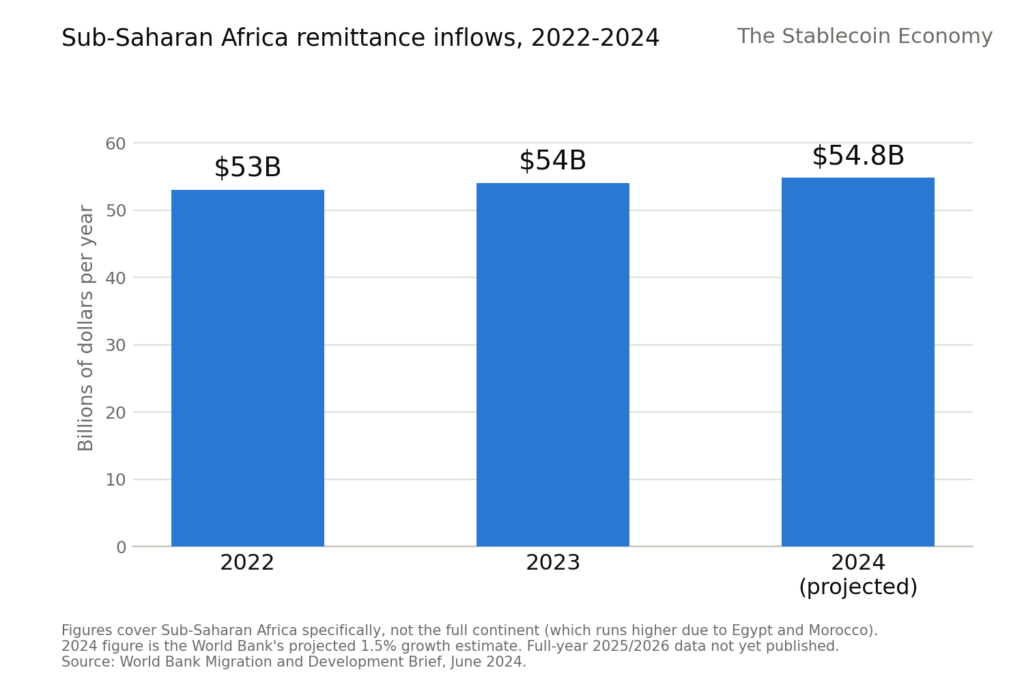
And because Africa’s cross-border payments market is expanding fast, with remittance flows now topping $100 billion a year, whatever Kenya lands on could end up as a template other countries borrow from.
A fintech leader facing a new test
Kenya earned its reputation as one of Africa’s fintech leaders through mobile money, and M-Pesa in particular rewired how ordinary Kenyans move cash. Now the country is facing a similar inflection point with crypto, except this time the technology arrived faster than the rulebook.
Industry executives estimate Kenyans are moving something like $500 million in stablecoins every month. That’s not speculative trading money — stablecoins hold a fixed value by design, which is exactly why they’ve become useful for real commerce, remittances, and cross-border settlement rather than just another asset to bet on.
At that scale, regulators can’t keep treating this as a fringe activity to monitor from a distance.
Nobody agrees on who’s actually in charge
Moreover, the most basic question still doesn’t have a clean answer: who regulates stablecoins in Kenya?
The Central Bank of Kenya has a claim, since stablecoins function as payment instruments. The Capital Markets Authority has a claim too, since they behave like digital investment assets. It’s entirely possible oversight ends up split across multiple agencies, which sounds sensible in theory but tends to leave gaps in practice — the kind of gaps where businesses stall out on uncertainty and consumers end up under-protected simply because nobody was clearly responsible.
Then there’s the awkward fact that Kenya has already started taxing something it won’t officially recognize.
The 2023 Digital Asset Tax, administered by the Kenya Revenue Authority, pulled revenue out of crypto transactions well before any real regulatory framework existed to define what was being taxed or why. The government frames it as ordinary revenue mobilization; crypto firms see a contradiction they can’t easily work around — taxed as an asset class, but still not legal tender.
For a founder or investor deciding where to put money, that kind of ambiguity often matters more than the actual tax rate.
The remittance opportunity is the real prize
This is where the stakes go well beyond Kenya. Africa pulled in an estimated $100 billion in remittances in 2024, money that families depend on for school fees, medical bills, rent, and daily expenses. The traditional rails for moving that money across borders are still slow and expensive — international transfers can take days and eat into the amount that actually arrives. Stablecoins offer a genuine alternative: settlement in minutes instead of days, at a fraction of the cost.
That matters even more as the African Continental Free Trade Area rolls out and businesses start trading across borders more routinely. Faster, cheaper digital settlement infrastructure stops being a nice-to-have and starts becoming a competitive necessity.
None of this is happening because people find crypto exciting. It’s happening because stablecoins solve a problem traditional finance has failed to solve cheaply: moving money across a border without losing a chunk of it to fees and delays, and without waiting days for it to land.
However, regulators aren’t being paranoid when they flag money laundering, terrorist financing, fraud, capital flight, and the perennial question of whether stablecoin reserves are actually backed the way issuers claim. The past few years have given them plenty of evidence — several high-profile crypto collapses have made “trust us” a much harder sell to any finance ministry. The genuine difficulty for Kenyan policymakers is building safeguards against those risks without regulating the innovation out of existence in the process.
What Kenya decides won’t stay in Kenya
Kenya isn’t working through this alone. Nigeria, South Africa, and a handful of other African economies are drafting their own digital asset rules at roughly the same time, which means there’s a real chance for divergence — or convergence, if one country’s approach proves workable enough for others to adopt.
If Kenya lands on a clear licensing regime with real consumer protections and sorts out who’s actually in charge of oversight, it strengthens its claim as the continent’s leading fintech hub.
Get it wrong, or leave it murky for too long, and capital simply moves to wherever the rules are clearer.
The conversation has shifted from should this exist to how do we govern it, which is progress, even if the harder work — aligning tax policy with licensing, assigning clear regulatory ownership, figuring out where stablecoins actually sit in the financial system — is still ahead.
Mobile money was Kenya’s first fintech revolution. How it handles crypto regulation over the next few months may decide whether it gets to lead the next one too.