



In Africa, the two global payment platforms, Visa and Mastercard, have long fought over card fees, merchant networks and loyalty perks. The rivalry has now moved onto newer terrain, one built from blockchains rather than plastic.
Both companies are racing to control the infrastructure that will let digital dollars move across borders in seconds.
Africa, with its costly remittance corridors and its enormous mobile money base, has become one of the clearest test beds for that fight.

As OG Attah, a capital markets and digital asset analyst at Dynamiq Alpha, put it, “Visa is building around the rails.” The question now facing both networks, he argues, is “who will control the infrastructure that moves stablecoin liquidity globally.”
A scramble for dominance in Africa’s market
The latest twist involves a scramble rather than a triumph.
For instance, Mastercard closed its purchase of BVNK, a London based stablecoin infrastructure firm, earlier this month. The deal, worth up to $1.8 billion, gave the firm a direct ownership of a company that had quietly been settling stablecoin transactions for Visa Direct since January. Losing a key vendor to a direct rival is an awkward position for any company.
On its part, however, Visa has responded by issuing a request for proposals to find a replacement, one capable of swapping and settling multiple stablecoins across the United States, Canada, Britain and Singapore. Few firms hold licences in all four jurisdictions, which narrows the field considerably.
The urgency reflects a bigger project.
Visa, Mastercard and Stripe are among more than 140 companies backing Open USD, a jointly owned stablecoin designed to work across many tokens rather than promote a single branded coin.
Visa launched its own Stablecoin Platform in July, with Open USD as the first supported asset, giving banks and fintechs tools to store, redeem and move digital dollars.
The message from both networks is consistent. They no longer want to merely accept stablecoins as a novelty. They want to own the rails that move them.
Why Africa matters to both firms
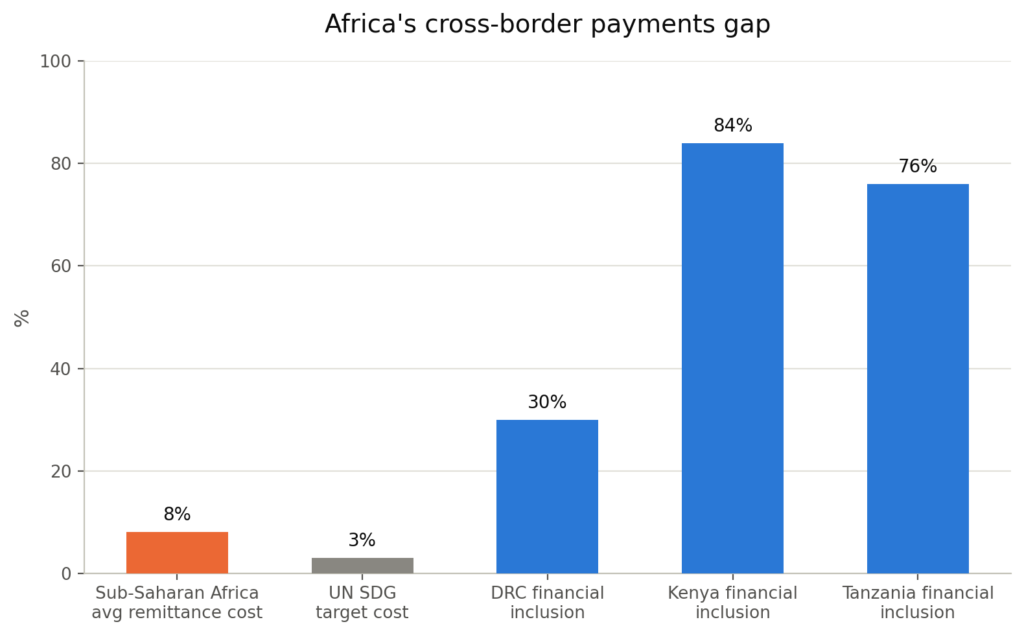
Africa is where this ambition meets its sharpest test. Cross-border payments across the continent remain notoriously expensive. The World Bank puts average remittance costs in sub-Saharan Africa near 8% of the transfer amount, roughly double the global target set by the United Nations.
Correspondent banking, the system that routes most international transfers through a chain of intermediary banks, adds delay and fees at every step. Indeed, mobile money has solved much of the domestic payments problem, with Africa now accounting for around two thirds of global mobile money value. But sending funds across a border still often means falling back on slow, costly banking rails.
Visa’s answer has been a quiet pilot in the Democratic Republic of Congo. Working with Safaricom’s M-Pesa and the pan-African network Onafriq, Visa has begun settling mobile money wallet top-ups using dollar pegged stablecoins behind the scenes, through a system called VisaPay.
On their parts, users notice nothing different. They top up a wallet as before. But the settlement layer beneath the transaction now runs on blockchain rails rather than correspondent banking.
Congo was chosen deliberately. Financial inclusion there sits near 30%, far below Kenya’s 84% or Tanzania’s 76%, according to FSD Africa, making it fertile ground to test whether digital dollars can leapfrog weak banking infrastructure.
Meanwhile, the choice carries a wrinkle too. Congo’s central bank has pushed hard against dollarisation and wants the franc used more widely. A settlement system built on dollar tokens sits awkwardly next to that goal, even if consumers never see it directly.
Mastercard has taken a different route into the same region.
In May, it partnered with Yellow Card, an Atlanta based stablecoin infrastructure firm with operations across more than 30 African countries, to expand stablecoin payments into Kenya, Ghana, Nigeria, South Africa and the United Arab Emirates.

The partnership covers cross-border transfers, business payments and treasury management. Notably, Yellow Card already works with Visa too, on treasury and liquidity operations, which makes it something close to neutral plumbing that both networks depend on. That overlap says something about the current phase of the stablecoin race.
Rather than each company building an isolated system, both are leaning on shared African infrastructure providers while competing hardest at the settlement layer above them.
Visa has also been widening its footprint through a software kit that lets banks and fintechs plug its VisaPay product directly into their own apps, launched in July across Ghana, Congo, Sudan, Zambia, Zimbabwe, Botswana, Tanzania and several other markets.
Kenya was left off that particular list, but not because Visa is retreating there. The company already runs deep infrastructure work with Kenswitch to modernise how Kenyan banks clear and settle domestic transactions, alongside its consumer facing tie-up with M-Pesa.
The first mover race to influence a payment rail
None of this guarantees stablecoins will reshape African payments quickly. Regulators across the continent remain wary. Kenya and Nigeria have historically treated cryptocurrency with suspicion, citing capital flight and threats to monetary sovereignty.
Congo’s tension between dollar stablecoins and its own currency goals illustrates the kind of friction that could slow adoption elsewhere.
Pilots are not products, and enthusiasm from payment executives does not always translate into usage by ordinary customers moving small sums between countries.
Still, the direction is unmistakable. Visa and Mastercard are no longer treating stablecoins as a curiosity sitting at the edge of crypto markets. They are treating them as core settlement infrastructure, worth billions in acquisitions and worth building around even before regulation fully catches up.
Whoever ends up controlling the pipes that move digital dollars across Africa’s borders will hold real influence over how the continent’s next generation of payments works. Both companies clearly intend that influence to be theirs.