


Venezuela did not adopt stablecoins because of a DeFi trend. It adopted them because the bolívar stopped functioning as money.
The bolívar lost around 70% of its value in 2025 alone, and annual inflation reached 229% by May of that year, according to the Venezuelan Finance Observatory.
TRM Labs recorded $17.9 billion in Venezuelan crypto volume in the first quarter of 2026, with USDT making up 90.2% of listings on Binance’s peer-to-peer market. Locals simply call it “Binance dollars.” Around 60 to 70% of transactions in the country now touch the US dollar or a dollar-pegged token in some form.

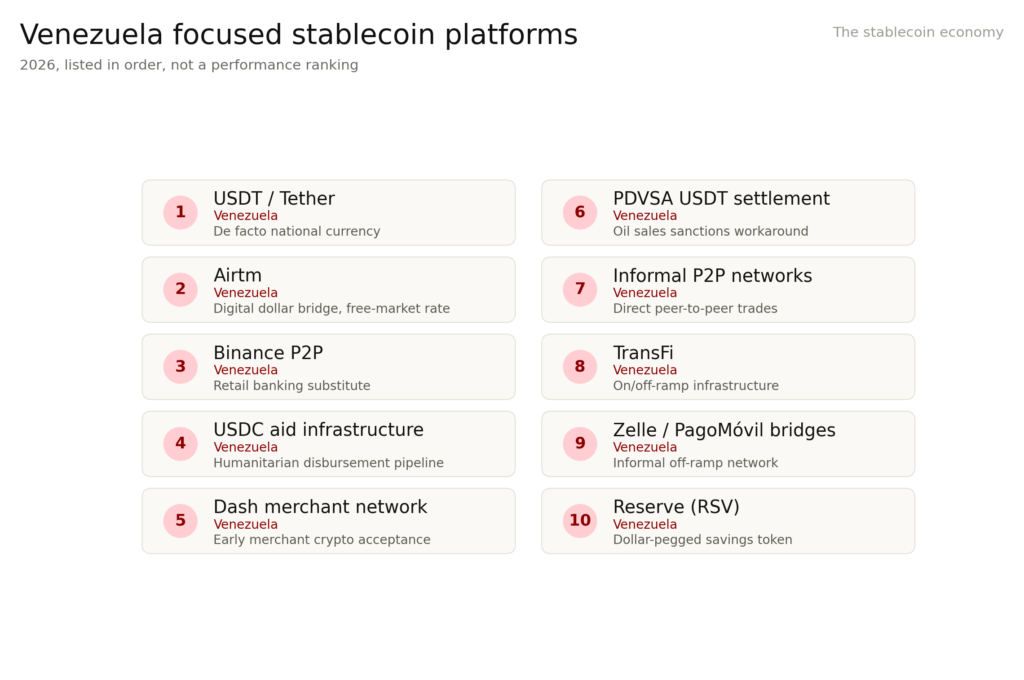
Below are ten platforms Venezuelans actually use to hold, send and spend dollar-pegged value, followed by what makes each one distinct.
Ten platforms powering Venezuela’s stablecoin economy
10. Reserve
Reserve issues RSV, a dollar-pegged token distinct from Binance’s USDT-dominated market, and has positioned itself specifically around helping Venezuelans and other users in developing economies save and transact without relying on a single centralized issuer.
9. Zelle and informal PagoMóvil bridges
Not a crypto platform at all, but Venezuelans routinely bridge USDT balances into PagoMóvil, Mercantil, Banesco and Provincial bank transfers, or into Zelle where family abroad can help, forming an informal off-ramp network that sits alongside the formal P2P exchanges.
8. TransFi
TransFi provides on- and off-ramp infrastructure that lets Venezuelan businesses and freelancers convert stablecoin income into usable local payments, filling gaps left by a banking system many Venezuelans no longer trust.
7. LocalBitcoins-style P2P networks
Before Binance P2P dominated, Venezuela was one of the largest markets globally for direct peer-to-peer bitcoin and stablecoin trades, and informal P2P desks operating over messaging apps and local escrow remain a meaningful channel outside the major platforms.
6. PDVSA’s USDT settlement system
Venezuela’s state oil company began requiring USDT for a share of crude oil payments starting in 2023, with the practice deepening through 2024.
Economist Asdrúbal Oliveros estimates roughly 80% of Venezuela’s oil sales revenue now settles in USDT, making the state itself one of the country’s largest stablecoin users, alongside the sanctions-evasion motive that drove the shift.
5. Dash merchant network
Dash built an early merchant acceptance network in Venezuela, and some shops and cafes in major cities still accept it alongside Bitcoin, though USDT has since become the dominant everyday settlement asset.
4. USDC aid disbursement infrastructure
Circle partnered with the Venezuelan opposition government and Airtm in a first-of-its-kind pipeline that minted USDC from seized government funds and distributed it to healthcare workers as AirUSD, avoiding the domestic banking system entirely. It became a template other humanitarian efforts in sanctioned economies have since studied.
3. Binance P2P
The single largest venue for converting bolívars into USDT or Bitcoin, Binance P2P trading volume rose 75% by mid-2021 and has only grown since, with USDT-VES listings now making up the overwhelming majority of all pairs traded. It functions as Venezuela’s de facto retail banking substitute.
2. Airtm
Airtm bridges “digital dollars” into local currency withdrawals at free-market rather than government-controlled rates, through a network of forex agents across Latin America. It became a lifeline when other dollar channels were blocked and now offers a virtual debit card that lets users spend stablecoin balances online without ever touching a Venezuelan bank.
1. USDT itself, via Tether
More than any single company or app, Tether’s USDT is the platform. It underpins payroll, remittances, vendor payments, and oil settlement across Venezuela, and functions as what TRM Labs calls the country’s primary transactional and savings tool, driven by domestic necessity rather than market cycles.
Bottom line

Venezuela is the clearest example anywhere of stablecoins becoming genuine financial infrastructure rather than a trading product.
There is no real DeFi yield farming scene to speak of, because the far more urgent problem stablecoins solve here is simply getting and keeping dollars.
Anyone assessing this market should weigh regulatory uncertainty around SUNACRIP, the premium P2P sellers charge during moments of political stress, and the reality that Venezuela’s stablecoin economy is a survival mechanism first and an investment opportunity a distant second.