


Argentina has the highest per-capita stablecoin adoption in Latin America, and the reason traces back to a national memory rather than a trend.
The corralito deposit freeze of December 2001 wiped out savings and left Argentines deeply distrustful of banks. Annual inflation has cooled from prior triple-digit levels but still sits in the low 30% range, and Argentines are estimated to hold around $271 billion in undeclared cash dollars outside the formal banking system.
Stablecoins have become the digital version of the same instinct: convert pesos to dollars the moment they arrive, and hold them somewhere a government cannot freeze.
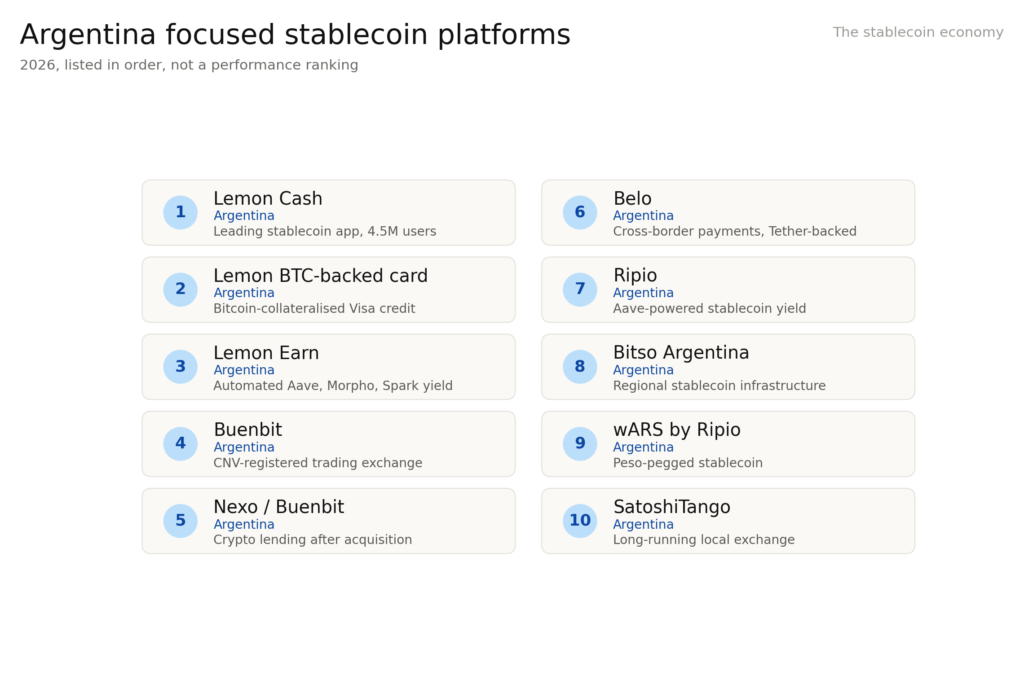
Below are ten platforms built for or heavily used across Argentina, followed by what makes each one distinct.
Ten platforms powering Argentina’s stablecoin economy
10. SatoshiTango
One of Argentina’s longer-running exchanges, SatoshiTango has kept a loyal user base among traders who prioritise a straightforward peso on-ramp over flashier consumer features.
9. wARS by Ripio
Ripio, which reaches four million app users directly and 25 million across Latin America through business partnerships, launched wARS in November 2025, a stablecoin pegged to the Argentine peso designed to make cross-border payments and local settlement smoother than routing everything through dollar tokens.
8. Bitso Argentina
Bitso’s Argentine operation gives users access to the company’s broader regional stablecoin infrastructure, including Bitso Onchain’s DeFi trading layer, alongside the peso on-ramps it has built out since entering the market.
7. Ripio
Serving four million app users directly in Argentina and Brazil, Ripio routes idle stablecoin balances into Aave to generate yield automatically, while also holding a crypto treasury reported at more than $100 million.
6. Belo
Backed by a $14 million Series A round led by Tether in April 2026, Belo combines payments, foreign exchange and cross-border transfers in one app, integrates Aave for automated dollar savings, and offers cashback ranging from 2% to 21% on card spending. It is expanding into Mexico, Chile, Colombia, Peru, Bolivia and Paraguay.
5. Nexo, following its Buenbit acquisition
Swiss crypto lender Nexo agreed in December 2025 to acquire Buenbit, gaining Argentine regulatory approval and access to Buenbit’s user base. The deal is expected to bring Nexo’s crypto-backed loans and high-yield savings products into the Argentine market through Buenbit’s existing licence.
4. Buenbit
Founded in Buenos Aires in 2017, Buenbit built one of Argentina’s most downloaded crypto apps around a simple mobile interface for converting pesos into stablecoins, and uses Aave to generate yield on customer deposits. It is registered with Argentina’s securities regulator, the CNV, and also operates in Mexico, Peru and Colombia.
3. Lemon Earn
Lemon’s yield product connects nearly 200,000 users to Aave, Morpho and Spark automatically, without requiring external wallets, private keys or smart contract interaction, advertising annual rates above 10% on USDC and USDT with daily payouts. Users have generated more than $1.3 million in yield through the product since it launched.
2. Lemon Cash’s Bitcoin-backed card
Launched in January 2026, Lemon’s Bitcoin-collateralised Visa credit card lets users borrow pesos against BTC holdings without selling them, a product aimed squarely at Argentines who want credit without a formal credit history, addressing a gap traditional banks have left unfilled for years.
1. Lemon Cash
Argentina’s leading crypto app, with 4 to 4.5 million registered users primarily across Argentina and Peru, Lemon Cash combines a Visa debit card, Bitcoin cashback, daily yield on holdings, fractional stock access and peso-to-stablecoin conversion in a single product. It processed $5.9 billion in transaction volume in 2024 alone, with 78% of deposits held in stablecoins.
Bottom line

Argentina’s stablecoin market looks less like speculative DeFi and more like a parallel banking system built out of daily necessity.
Aave sits quietly underneath several of the country’s biggest consumer apps, turning what looks like a simple savings feature into real decentralized lending exposure.
Starting with a regulated local app, understanding that yield products carry real smart contract and market risk even when the interface feels like a savings account, and watching how peso-pegged tokens like wARS develop will put any new Argentine investor in a stronger position.