



Argentina has long been a laboratory for crypto adoption born out of necessity. New data from a16z crypto and Artemis shows just how deep that habit now runs: 94% of peso denominated crypto transactions in the country flow into stablecoins, the highest share among any of the major currencies Artemis tracks.
Roughly one fifth of Argentina’s population now uses cryptocurrency, one of the highest penetration rates anywhere in Latin America, and for most of them, buying crypto simply means buying digital dollars.
A Crisis Habit That Outlived the Crisis
The pattern took shape during Argentina’s worst inflationary years. Monthly inflation once peaked near 25.5%, and annual inflation reached 289% in April 2024, a level that shredded the value of peso savings almost in real time. Facing strict foreign exchange controls that made it difficult to legally buy and hold US dollars, Argentines turned to dollar pegged stablecoins like USDT and USDC as a workaround.

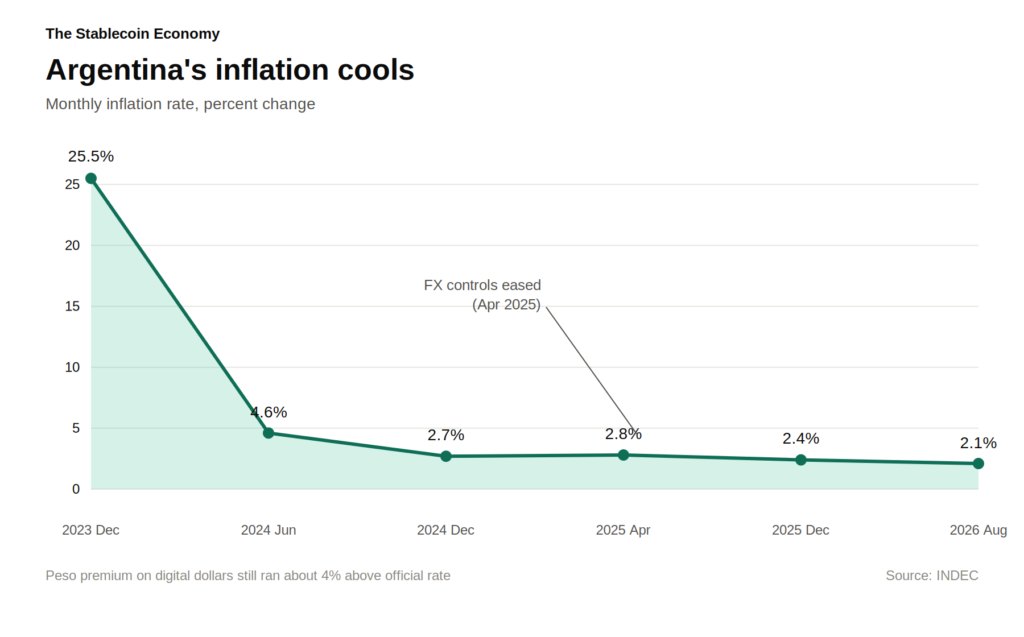
What is notable is that the habit did not fade once conditions improved. Monthly inflation has since fallen all the way to about 2.1%, and after most personal foreign exchange restrictions were lifted in April 2025, the gap between the official exchange rate and the crypto dollar narrowed sharply.
Independent research on Argentina’s currency markets confirms the premium that once made stablecoin arbitrage so lucrative has largely closed, from highs above 30% in 2022 to close to parity in 2026.
Yet as of August 28, 2026, digital dollars were still trading about 4% above the official rate, a small but persistent gap that keeps the trade alive out of routine rather than emergency.
Wages, Wallets and a Market That Kept Growing
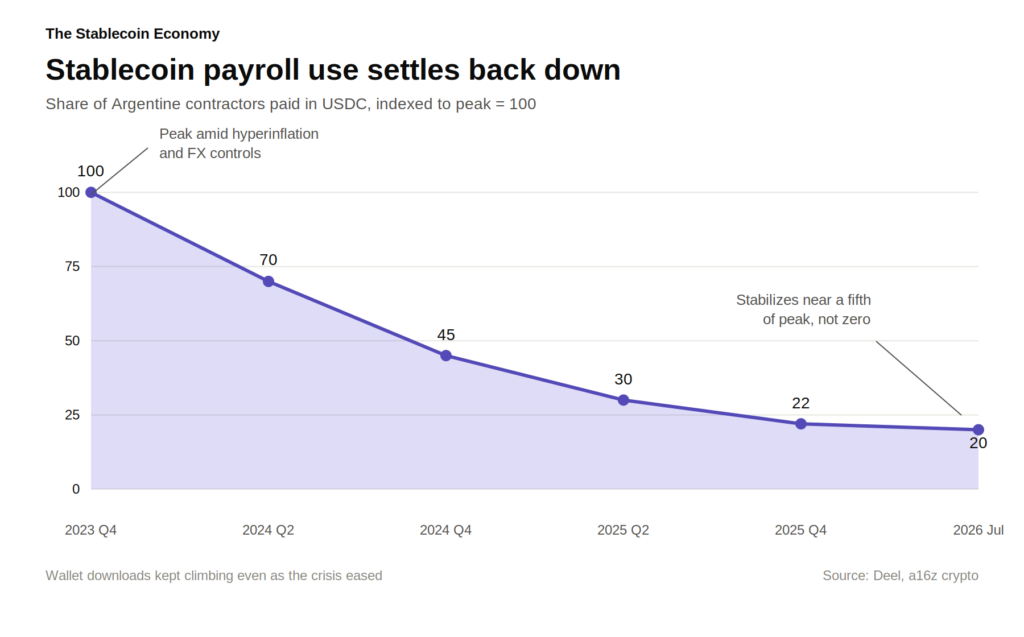
The clearest evidence that stablecoins moved from crisis tool to everyday infrastructure comes from payroll data. Deel, which processes contractor payments globally, found that the share of Argentine contract workers receiving pay in USDC rose in step with inflation during the worst years, then declined and stabilized once prices calmed down. By July 2026, that share sat at roughly one fifth of its peak, a decline that closely tracks the drop in inflation itself rather than disappearing altogether.
Wallet growth tells a similar story. Downloads of Argentina’s top fifteen crypto apps jumped 93% year over year in 2024, and platforms such as Lemon kept adding users quarter after quarter even as monthly inflation kept falling.
Lemon, now one of the country’s largest digital asset exchanges with millions of users, has expanded well beyond simple currency conversion, rolling out debit cards, and even a Bitcoin backed credit card in January 2026 that lets users borrow pesos against BTC collateral without selling it.
Separately, research from Artemis has flagged Argentina as a global outlier where USDC usage approaches near parity with USDT, a split seen in almost no other market.
From Emergency Exit to Everyday Tool
Taken together, the numbers describe a shift in purpose rather than a shift in usage. Stablecoins were adopted as an emergency exit from hyperinflation and currency controls; they are increasingly staying on as a normal way to save, get paid and spend. Families and contract workers who once rushed to convert pesos into digital dollars out of urgency now do so as routine, and wallets like Lemon are building consumption cards and payroll tools around that expectation rather than around crisis management.
Winners, Losers and What Comes Next
The mechanics of this market are straightforward. Buyers are households and freelancers who want to move pesos into digital dollars quickly; sellers are the stablecoin issuers, USDT and USDC, and the local wallet platforms that provide the exchange rails. Funds are steadily migrating out of peso denominated demand deposits and into dollar stablecoins, a flow that benefits wallets and stablecoin issuers offering exchange, payroll and card services, while traditional banks that still rely on peso deposits face growing pressure.
Whether this settles into a permanent feature of Argentina’s financial system or eventually recedes further as trust in the peso rebuilds is still an open question. But with inflation falling and usage nonetheless holding well above pre crisis levels, the early signs point toward stablecoins becoming a durable, everyday part of how Argentines manage money rather than a temporary fix for a fading crisis.