


Key takeaways:
- Crypto card spending reached $759 million in July, up 2.5 times from $306 million a year earlier
- Nearly nine million crypto card purchases were completed in July, averaging about $86 per transaction
- USDC and USDT now account for roughly 84% of tracked crypto card spending
Crypto payment cards are moving beyond their early niche, with monthly spending surpassing $750 million as stablecoins become an increasingly popular way to fund everyday purchases.
Monthly crypto card volume reached $759 million in July, according to onchain data highlighted by a16z crypto and tracked by Paymentscan. That represents a roughly 2.5-fold increase from $306 million a year earlier, and a dramatic rise from less than $1 million when tracking began in October 2023.
The cards allow users to spend crypto wherever conventional card networks are accepted, with stablecoins typically converted into local currency at the point of sale so merchants receive payments through familiar card infrastructure without directly handling digital assets.
Crypto card purchases approach 9 million
In addition, transaction numbers have climbed alongside spending volume. Consumers completed nearly nine million purchases with crypto payment cards in July, compared with approximately 5.2 million a year earlier, putting average spending at roughly $86 per transaction.
Crypto cards can offer an alternative payment route for people without traditional bank accounts, particularly in regions where access to US dollar products is limited. Depending on the provider, customers may deposit stablecoins with a centralized card issuer or retain their assets onchain through a self-custodial wallet.

The Paymentscan figures primarily reflect onchain activity associated with the card programs it tracks, though spending data for RedotPay, the largest program by volume, is reported by the issuer rather than directly observed onchain.
Despite the rapid growth, the sector remains small compared with established card networks, which process trillions of dollars in payments every month.
Optimism, Solana, and Base gain market share
Meanwhile, the infrastructure supporting crypto cards has also become more diverse. In early 2024, most tracked card spending settled on Gnosis, which hosts Gnosis Pay, described as the first Visa card connected directly to a self-custodial wallet. As additional card products launched, activity spread across several blockchain networks.
Optimism accounted for approximately 29% of crypto card spending in July, while Solana and Base each processed about 19%, and Gnosis’s share fell to roughly 2%.
The shift suggests crypto card providers are increasingly choosing scalable networks capable of handling frequent, relatively low-value consumer transactions, reducing the market’s previous dependence on a single settlement chain.
For the card programs covered by Paymentscan, transactions are routed almost entirely through Visa’s payment network, allowing crypto-funded purchases to use infrastructure already accepted by millions of merchants.
Dollar stablecoins dominate crypto card spending
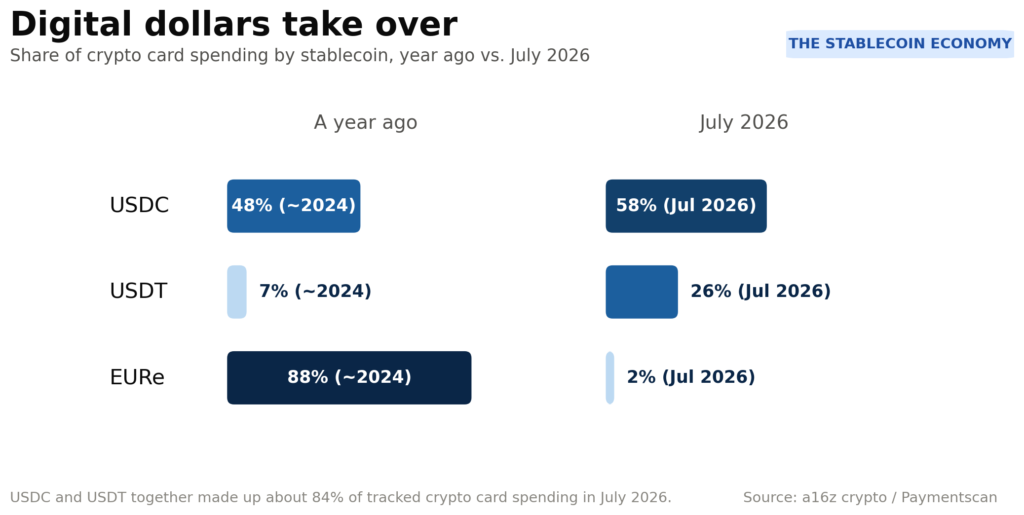
The assets used to settle card transactions have changed even more sharply than the overall volume. In early 2024, euro-backed EURe accounted for around 88% of tracked crypto card volume, largely due to its use on Gnosis. By July, its share had declined to approximately 2%.
Dollar-backed stablecoins now dominate the market.
USDC processes around 58% of crypto card spending, up from about 48% a year ago, while USDT’s share has risen from roughly 7% to 26% over the same period.
The two assets together account for approximately 84% of tracked spending, showing that crypto card activity now occurs overwhelmingly in digital dollars.
The growth reflects stablecoins’ expanding role as both stores of dollar-denominated value and practical payment instruments. Crypto cards bridge that onchain liquidity with existing card rails, giving holders a way to spend stablecoins without requiring merchants to adopt new payment systems.