


Businesses across the continent are turning stablecoins into everyday financial tools, not trading chips
For years, stablecoins in Africa were mostly seen as a way for crypto traders to park money between bets. That picture is changing fast.
Payment companies, big card networks and even regulators are starting to treat stablecoins as something closer to plumbing. They move money. They settle trades. They help businesses survive currency swings that would otherwise eat into their profits.

The continent is becoming “the world’s toughest test lab for stablecoins” as the technology gets pushed into real payment infrastructure.
The problem stablecoins are solving
Many African businesses struggle to get their hands on foreign currency quickly, even when they have every right to it. A local currency can lose value in the days between an invoice being sent and the payment finally landing.
Cross border banking does not help much either. Payments often pass through banks outside the continent before they reach their destination. What should take minutes can end up taking days.
Stablecoins offer a shortcut. They move on blockchain networks, so businesses are not stuck waiting for banking hours. They also let companies sidestep some of the currency risk that comes with holding local money for too long.
This is why the loudest interest is coming from payment firms rather than crypto exchanges. Nobody is chasing speculation here. Companies just want faster access to dollars and fewer points of friction along the way.
Flutterwave and Yellow Card are leading the charge
Flutterwave has become one of the clearest signs of this shift. Over the past year the payments company moved beyond standard processing and added stablecoin balances, letting businesses and everyday users hold and move digital dollars through built in wallets.
Ripple went a step further and invested in Flutterwave as part of its Series E funding round. That investment brought Ripple Payments, the XRP Ledger and access to RLUSD into Flutterwave’s cross border operations, according to Tech in Africa. Circle Ventures followed soon after with its own investment aimed at supporting USDC settlement on the same platform.

These moves point to something bigger. Stablecoin issuers are no longer chasing retail crypto users alone. They want a seat inside the payment systems African businesses already rely on.
Yellow Card has taken a similar path. The company started out as a consumer facing crypto exchange and has since shifted toward enterprise stablecoin infrastructure. Its focus now sits on cross border settlement, treasury management and payments built through APIs. A partnership with Mastercard supports stablecoin payments across the EEMEA region too, another sign that commercial use has taken center stage.
Other players are following the same trail. Onafriq, which specializes in cross border payments, is exploring stablecoin settlement as a way to smooth out Africa’s fragmented payment landscape.
The numbers tell a story of real demand
This is not a passing trend built on hype. A 2026 Stablecoin Utility Report found that Africa has the highest stablecoin ownership rate among crypto active users anywhere in the world, ahead of both emerging and wealthier economies. The report tied that adoption to practical needs like dollar payments and savings rather than trading.
Chainalysis also tracked similar momentum. Its 2025 geography of crypto report found that Sub Saharan Africa received about 205 billion dollars in on chain value between mid 2024 and mid 2025. That marked a 52 percent jump from the year before. Stablecoins were increasingly used for payments, remittances and as protection against inflation.
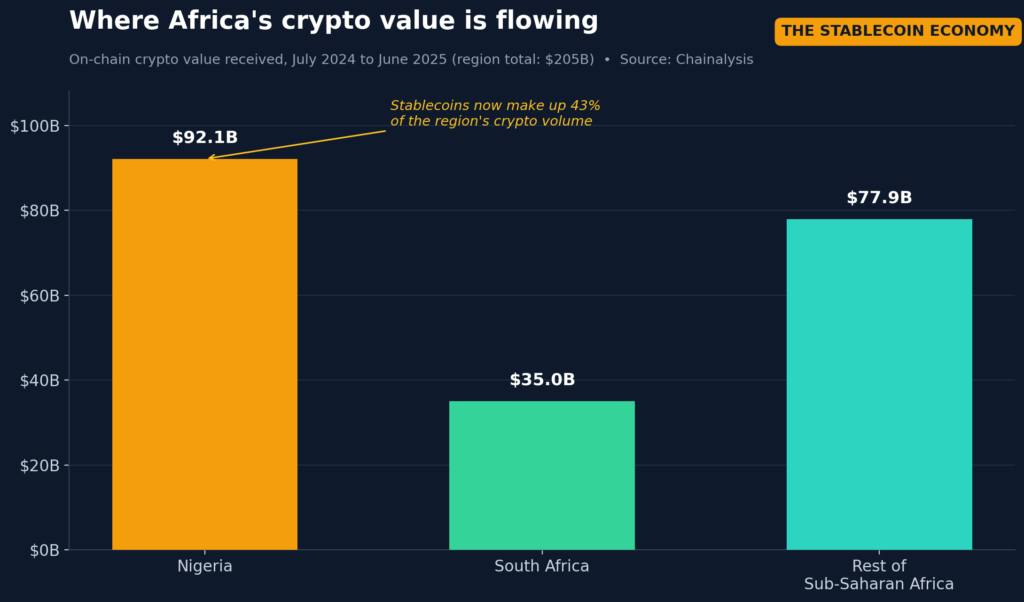
The difference matters. In many wealthier markets, stablecoins still get discussed mostly through the lens of crypto trading. In Africa, they behave more like basic financial infrastructure. Businesses are not debating whether blockchain is trendy. They simply want to know if it can help them pay suppliers, manage cash and hold value more efficiently.
Global payment giants are watching closely
Large global players have noticed the shift too. For instance, Visa has been expanding stablecoin settlement so issuers and acquirers can settle transactions directly over blockchain networks. In March, the company deepened its partnership with Bridge to bring stablecoin linked card products to more than 100 countries.
Stripe, which bought Bridge in 2025, has joined Visa, Mastercard, BlackRock and Coinbase to launch Open USD. The initiative aims to set common standards for dollar backed stablecoins used in commercial payments. Having these companies involved suggests the market is moving well past niche crypto infrastructure into mainstream settlement design.
This matters for Africa because the continent has long dealt with a costly payments problem. If blockchain settlement can cut out middlemen, speed up transfers and improve access to dollar liquidity, it could unlock real efficiency for importers, exporters and fintechs working across borders.
The real test will be whether these systems can grow without recreating the same bottlenecks they were built to fix.
Regulators are catching up, just not at the same pace
On the other hand, policy is starting to follow the market, though progress looks different from country to country. South Africa remains one of the more advanced jurisdictions, with crypto asset service providers already operating under a licensing regime run by the Financial Sector Conduct Authority. More rules covering stablecoin issuers and reserves are also being considered.
Nigeria has chosen a different route. Its 2025 Investments and Securities Act placed digital assets under the watch of the Securities and Exchange Commission, while the naira pegged cNGN stablecoin shows an attempt to fit blockchain products into existing law. Kenya is refining its own virtual asset framework, including proposed rules on reserve management and issuer licensing. Zimbabwe and Ghana have started exploring similar ground.
This regulatory movement matters because stablecoins cannot function as serious payment infrastructure without trust. People need confidence in reserves, redemption and oversight. Policymakers now face the challenge of supporting innovation without leaving consumers exposed to weak backing or poor disclosure.
Why Africa could shape what comes next
The bigger story here goes beyond growth numbers. Africa is forcing stablecoins to prove themselves under conditions that few other markets can match. Currency volatility, patchy banking links and expensive cross border transfers create a real world stress test that wealthier markets rarely face.
If stablecoins can hold up here, they can likely hold up anywhere. If they fail, the cracks will show quickly. This is why Africa is increasingly viewed not as a side market for digital dollars but as the place where their real usefulness gets measured.
For now, the direction feels clear. Businesses want faster settlement. Fintechs want cheaper rails. Global payment groups want a foothold in the infrastructure layer. What happens next will depend on whether regulation, banking integration and reserve transparency can keep up with demand.