



Visa has picked the Democratic Republic of Congo as the testing ground for its newest stablecoin project. The card payments giant has teamed up with M-Pesa Africa and cross-border payments network Onafriq to settle mobile money transactions using stablecoins.
The pilot is small for now. But it could reshape how millions of people in Congo and across Africa send and receive money.
The idea is simple. A customer tops up their M-Pesa wallet like they always have. Nothing changes on their screen. Behind the scenes though the transaction settles in stablecoins instead of moving through the usual banking channels. Visa built a product called Visa Pay to make this happen and Congo is the first live market for it.

Godfrey Sullivan, who leads solutions for Visa, explained the thinking behind the pilot. “Cross-border remittance challenges are still significant and are yet to be solved,” he told International Finance. Stablecoins, he argued, are the missing piece that banks, fintechs and mobile network operators will increasingly turn to.
Why Congo became Visa’s stablecoin test market
Meanwhile, Congo is an unusual choice on paper but it makes sense once you look at the numbers. Only about 30% of adults in the country have access to formal financial services, according to Financial Sector Deepening Africa. That is far below neighboring Kenya, where the figure sits at 84%, and Tanzania, where it is 76%.
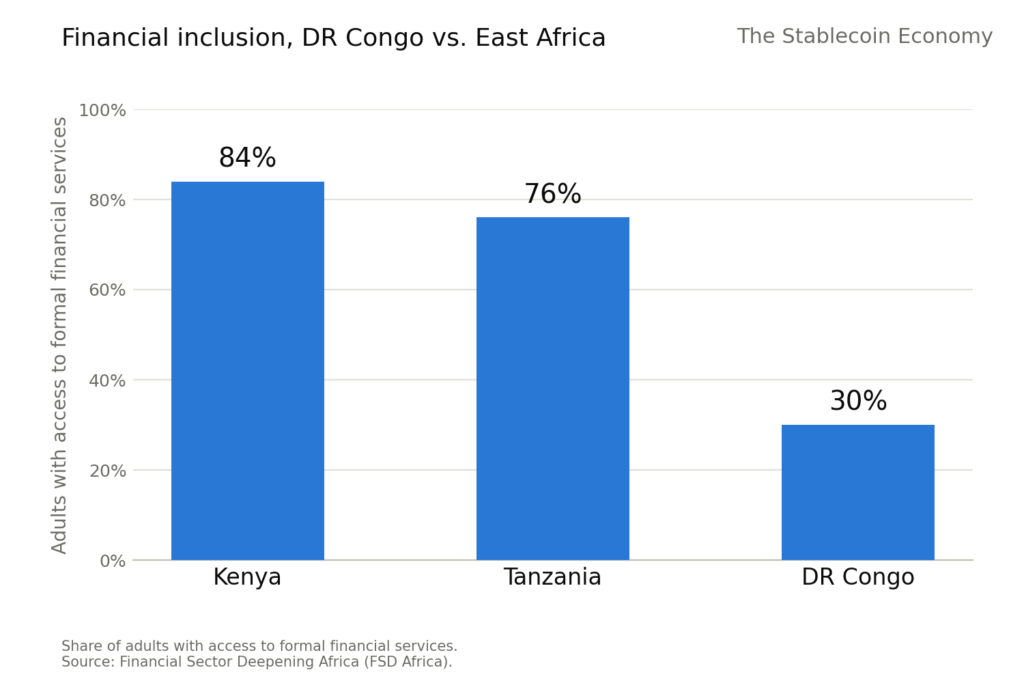
That gap is exactly what makes Congo useful for a stablecoin trial. Millions of people already rely on mobile money for everyday payments but have almost no reliable way to send money across borders without paying steep fees or waiting several days for a transfer to clear. Stablecoins settle in minutes rather than days, and at a fraction of the typical cost.
3 reasons Congo makes sense for Visa’s stablecoin pilot
1. Financial inclusion remains low
Congo is an unusual choice on paper but it makes sense once you look at the numbers. Only about 30% of adults in the country have access to formal financial services, according to Financial Sector Deepening Africa. That is far below neighboring Kenya, where the figure sits at 84%, and Tanzania, where it is 76%.
That gap is exactly what makes Congo useful for a stablecoin trial. Millions of people already rely on mobile money for everyday payments but have almost no reliable way to send money across borders without paying steep fees or waiting several days for a transfer to clear. Stablecoins settle in minutes rather than days, and at a fraction of the typical cost.
2. Mobile money is already mainstream
The timing also lines up with a much bigger trend. Sub-Saharan Africa processed $1.4 trillion in mobile money transactions in 2025, up 26% from the year before, according to industry group GSMA. Transaction volumes hit 96 billion, a 16% jump.
Africa now accounts for 67% of the world’s mobile money value and 74% of its transaction volume. East Africa alone drives 66% of that volume.
3. Cross-border payments remain expensive
In other words, the payment habits are already in place. What has been missing is a cheap and fast way to move money once it crosses a border. Stablecoins are Visa’s answer to that gap, and Congo is where the company chose to test whether the answer actually works.
Visa wants Congo to become its African blueprint
If the Congo pilot succeeds, Visa has been clear that it wants to expand the model to other African markets. Sullivan told FinTech Futures that “the transaction is settled in stablecoins in the background,” pointing to how little the customer experience actually changes. That is the part Visa seems most focused on getting right before it scales.
This is not Visa’s only stablecoin move on the continent either. In March, Visa and M-Pesa rolled out a tokenised tap to pay feature on the M-Pesa super app in Tanzania. Around the same time, rival Mastercard partnered with Yellow Card, a licensed stablecoin infrastructure provider, to test similar cross-border remittance use cases elsewhere in Africa.
That puts Congo at the center of a broader competitive race. Visa, Mastercard, and a growing list of fintechs are all betting that stablecoins will become the default settlement layer for cross-border payments in Africa within the next few years.
Whoever gets the model right first, without disrupting the mobile money habits people already trust, stands to gain a serious head start.
The regulatory redwall: Can stablecoins grow without deepening dollarization?
There is a catch though, and it is not a small one. Stablecoins used in this pilot are pegged to the US dollar. Congo already has an economy where the dollar circulates widely alongside the Congolese franc. A dollar-linked stablecoin can make payments faster and cheaper. It can also quietly deepen the country’s existing dependence on the dollar, a trend often called digital dollarization.
The Central Bank of Congo has its own goals here, and they point in a different direction. The bank wants to strengthen use of the Congolese franc, not weaken it further. That creates a real tension. A payments product that improves efficiency for ordinary users can, at the same time, work against a central bank’s efforts to protect its own currency.
This is not a problem unique to Congo. Nigeria has already dealt with similar concerns as dollar stablecoins became a popular way for residents to protect savings from a weakening naira. Regulators there have voiced worry about losing monetary control. Congo’s central bank is likely watching that experience closely.
Visa’s pilot is still early and success is not guaranteed. Partners will need to secure liquidity, follow local rules, and avoid the appearance that the product is simply a shortcut to holding digital dollars. If Visa cannot manage that balance carefully, the same regulatory caution that has shaped Nigeria’s stablecoin debate could easily catch up with Congo too, even as the payments case for stablecoins keeps getting stronger.