


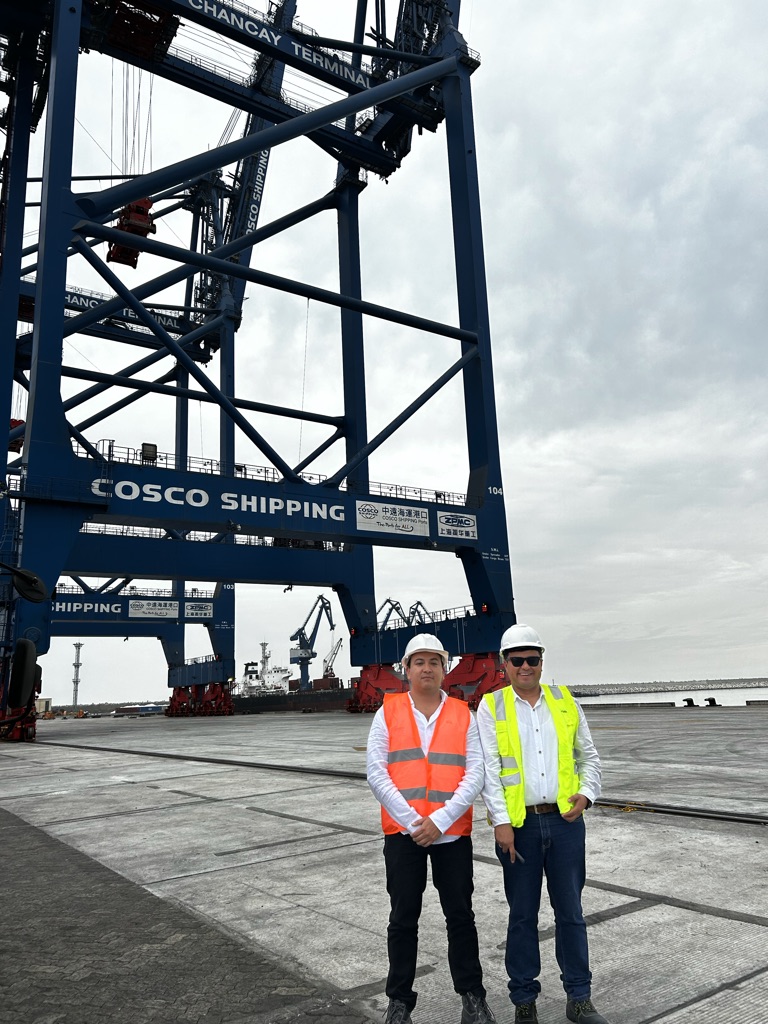
When the megaport of Chancay opened on Peru’s Pacific coast, most of the headlines were about ships: direct routes to Asia, transit times cut to 23 days, container volumes projected to double by 2030.
What got less attention is that every one of those containers drags a financial transaction behind it, and the financial infrastructure of the Asia-Latin America corridor has not sped up to match the ships.
Linka, the Peruvian trade-finance platform backed by Tether, is betting its next phase of growth on exactly that gap. And in a detail that cuts against the export-heavy framing most coverage has given Chancay, the company’s CEO, Victor Egoavil, says the port is, for its business, primarily an import story.

Two pinch points
“The importers bringing in that volume are on the hook to pay Asian suppliers before a single container leaves port,” the Egoavil explains to The Stablecoin Economy in an email. No shipment has happened, no goods are in hand, but the payment obligation already exists. That pre-shipment payment is the first pinch point in the corridor, and it’s where Linka inserts itself first, handling the payment to the Asian supplier on the importer’s behalf.
The second pinch point arrives weeks later, on the Peruvian side of the ocean. When the goods land, now sometimes just 23 days after departure thanks to Chancay, the importer needs cash or credit to clear customs before the product can reach a warehouse, let alone a shelf. An importer without liquidity at that moment is in the strange position of owning inventory it cannot touch. Linka’s answer is a customs loan at exactly that stage, financing the release of goods so working capital doesn’t become the bottleneck between the port and the market.
Taken together, the two products bracket the entire journey of a container: secure the payment before the ship leaves Asia, finance the release once it arrives in Peru.
This, the company says, is what “breaking into Asia” actually means for a Latin American fintech. “It doesn’t mean opening an office in Shanghai tomorrow. It means being the financial layer that sits on both ends of that route,” is how Linka frames it. And the Chancay math makes the opportunity compound: as container volumes double, the friction at both pinch points gets worse, not better, unless someone owns both sides of it.

There’s a subtle strategic logic here. Faster shipping doesn’t relieve the importer’s financial squeeze; it intensifies it. Shorter transit times mean the gap between paying the supplier and needing customs liquidity shrinks, cash conversion cycles tighten, and businesses that could once use the slow boat as an accidental financing buffer now need real financing instead.
Chancay is, in effect, manufacturing demand for exactly the product Linka sells.
Building the corridor, not the country
Meanwhile, the Asia strategy sits inside a broader thesis that Linka has been explicit about: it is building for the corridor, not just for Peru.
The network already spans Peru, Bolivia and Honduras, connected through 16 bank integrations across the three markets. Colombia, the company confirms, is now live: “that’s not a plan, that’s open.” And the next corridor is the region’s biggest prize: Brazil.
Notably, Linka is not going into Brazil cold. The expansion is being executed in partnership, a deliberate choice, the team says, given how different Brazil’s financial and regulatory environment is from the rest of the region. Brazil’s market is enormous but idiosyncratic: its own instant-payment rails, its own regulatory regime, its own banking oligopoly. A partnership-led entry trades some control for local fluency, and for a trade-finance company whose product touches customs, banking and FX in every market it enters, that fluency is not optional.
Asked what the company is looking for in Brazil, the answer is blunt: “the real money and the real big volumes,” Egoavil tells our reporter.
The expansion logic, the team stresses, is the same one that has governed every prior market entry. “We’re not trying to be a Peru company that occasionally touches other markets. We’re building the rails for how money and trade move across the whole corridor.” Each new country, Peru, Bolivia, Honduras, now Colombia, Brazil next, “isn’t a separate product, it’s another node on the same network.”
That framing is the difference between a regional trade-finance network and, in the company’s own words, “another local payments company with a few extra flags on the website.”
A payments company in five countries has five products. A network across five countries has one product that gets more valuable with every node, because trade, by definition, happens between nodes.
The stablecoin layer underneath
None of this exists in a vacuum. Linka’s main investor, has been aggressively expanding its own trade-finance ambitions, extending billions in credit to commodity traders and publicly showcasing Linka’s work, including the first-ever instant USDT settlement of Peruvian customs duties, as its answer to the question of what real-world stablecoin usage looks like.
The Asia to LatAm corridor may be the cleanest test of that thesis anywhere in the world. On one end: Asian suppliers who want payment certainty before goods ship. On the other: Latin American importers who need liquidity the moment goods land. In between: a correspondent-banking system that was never built for either of them, and a new port that is about to double the volume flowing through it.
The ships got faster. Linka is betting the money is next, and that whoever owns both ends of the corridor’s cash flow will matter more than whoever owns the warehouses.